DeFi scanner: Reading Scores Alongside Risk Flags
DeFi scanner combines security scores with contract findings, including pausing and blacklisting risks on supported networks. For pause and blacklist flags, check which operations they can restrict and under what conditions. The Safety Score and AI Score summarize different risk signals. Reading them beside the detailed findings helps distinguish contract capabilities, market risks, and unresolved restrictions. An overall rating alone cannot establish whether a particular operation remains available to your address.
Transfer Controls Behind the Score
When a token contract permits pausing or blacklisting, transfer availability can depend on administrative controls as well as the balance held. The Detector Tab flags these capabilities, whose consequences depend on the affected functions and the authority controlling them.
Pausable Operations
A pause mechanism can stop operations the contract subjects to its pause condition. Its scope matters: a restriction affecting transfers differs from one affecting another function. The presence of pause-related code also needs interpretation, since inheritance alone does not make every function pausable. A meaningful finding identifies the affected operation and how the pause can be triggered. A pausable-contract label describes a capability; an active pause describes the contract’s state.
Address Blacklisting
Blacklisting can restrict operations involving selected addresses, with the precise effect determined by the implementation. The relevant questions concern who controls list membership and which address checks the affected function applies. A restriction on particular addresses has a different reach from a pause covering transfers generally. Neither label, by itself, proves malicious intent or establishes whether the restriction currently applies to a particular holder.
What Do the Safety Score and AI Score Measure?
The Safety Score assesses contract and token-risk factors, while the AI Score examines behavioral signals.
Safety Score
The Safety Score considers contract code, governance, liquidity risks, and holder distribution. A code finding concerns contract behavior, while governance analysis concerns control over relevant decisions. Liquidity and distribution add market context. A favorable overall score therefore needs the accompanying findings to explain which risks remain relevant to the intended interaction.
AI Score
The AI Score evaluates Swapping Analytics, Organic Behavior, Reputation, Sybil Detection, and Utility. These dimensions add information about token activity beyond individual code findings. Sybil detection concerns activity involving multiple identities under common control, while organic behavior analysis examines activity patterns. The score combines these signals into a broad assessment; its headline value does not explain every input.
Liquidity and Holder Concentration Beside Contract Findings
Where the report includes liquidity and holder information, those observations add market context to the code analysis. Liquidity concerns the market available for exchanging tokens. Holder distribution describes how holdings spread across addresses. Concentration can matter when a small set of holders controls a large share of supply, although addresses do not establish how many people control those holdings. These observations answer different questions from whether a transfer function permits an operation, so a favorable finding in one category does not settle the others.
Scanner 2.0 expanded liquidity analysis in its December 2025 update. The additional detail helps distinguish how liquidity is structured from whether the contract contains a particular control. A transfer can be technically permitted while market conditions limit the terms available for exchanging the token. Conversely, visible liquidity does not remove an administrative restriction.
Contract Identity and Network Coverage
A report applies to a particular contract on a supported blockchain. A matching token name alone does not establish that the report covers the intended deployment.
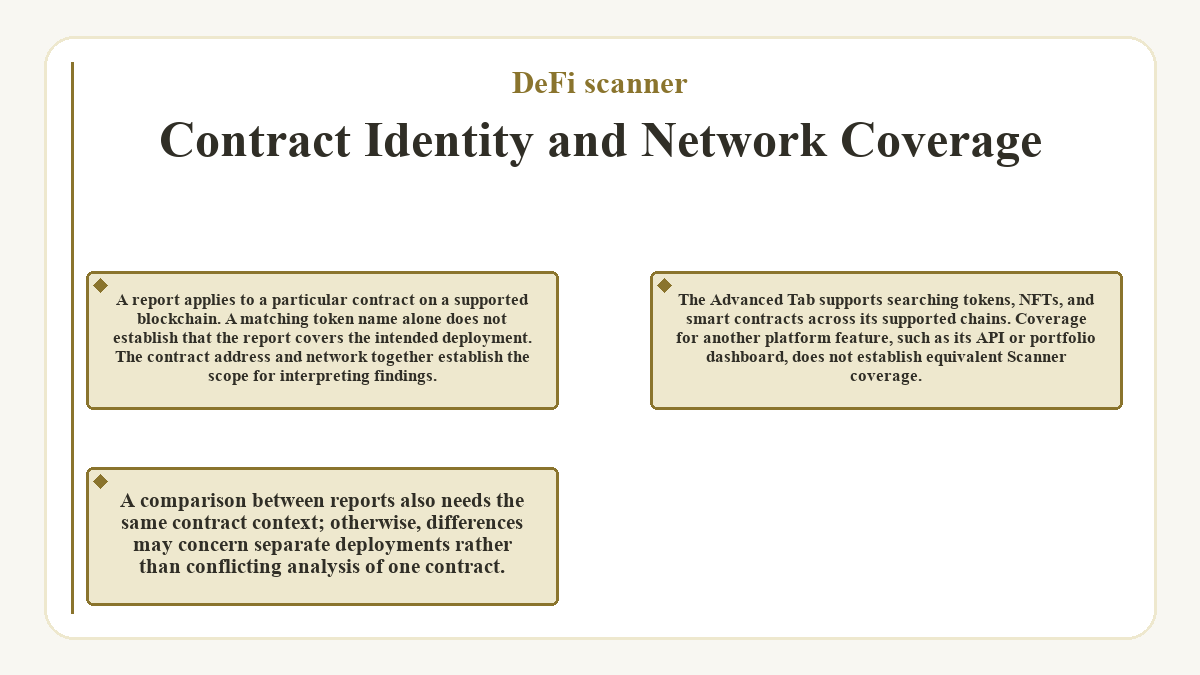
The contract address and network together establish the scope for interpreting findings. The Advanced Tab supports searching tokens, NFTs, and smart contracts across its supported chains. Coverage for another platform feature, such as its API or portfolio dashboard, does not establish equivalent Scanner coverage. A comparison between reports also needs the same contract context; otherwise, differences may concern separate deployments rather than conflicting analysis of one contract.
Transfer Flexibility Before Interaction
When preserving a later transfer is the priority, should an explained pause capability and an active transfer pause lead to the same decision? Compare their effect on the same intended operation, using the report’s detailed findings alongside its scores.
- Confirm the report covers the intended contract address and supported network.
- If pausing appears, identify the affected operation and whether the pause condition currently blocks it.
- If blacklisting appears, establish whether the relevant address falls within the restriction.
- Keep liquidity concerns separate from the contract’s permission to transfer tokens.
- If the relevant state remains unclear, do not infer transfer availability from the score.
A callable pause function creates a potential future restriction while transfers remain unpaused. An active pause blocks only operations subject to its condition. Postpone the token interaction if the relevant restriction remains unclear. A later state change can invalidate an earlier conclusion about transfer availability.
Conflicting Findings and the Limits of a Scan
When a scanner finding conflicts with an audit, the disagreement needs an explanation tied to the same deployment and relevant contract behavior. An audit’s publication date, reviewed version, and stated scope help establish whether the reports address the same issue.
A finding about an available administrative power can coexist with an audit reporting no exploitable code defect. The audit may assess whether the implementation follows its intended design; the scanner may flag a power whose intended use still affects holders.
A missing warning does not prove a contract is safe. Automated analysis helps locate questions for closer examination; it cannot establish every future contract state or market condition. Reentrancy, for example, concerns contract execution behavior and requires a different explanation from holder concentration.
DeFi scanner: what people ask
Does an Example Inside a Scanner Finding Come From the Selected Contract?
An example may illustrate a vulnerability pattern without reproducing the selected contract’s code. The scanner provides examples where appropriate alongside explanations of findings. Relevance to a particular contract comes from the affected function and conditions identified in that finding, not from the example’s name alone.
Are NFT Scores Directly Comparable With fungible-token Scores?
A shared score label does not make the underlying contract functions equivalent. The Advanced Tab supports searching NFTs as well as tokens and smart contracts. Interpret each report through the operations its findings actually cover, without carrying a fungible token’s liquidity or transfer assumptions into an NFT assessment.
Which Technical Issues Does the Scanner Examine Beyond Transfer Restrictions?
The scanner examines issues including reentrancy, unchecked transfers, control flow, and privileged-function setup. It also checks Solidity practices and ERC standards. Those technical categories extend beyond pause and blacklist controls, so the detailed findings can concern execution behavior as well as administrative permissions.
Is the AI Score a Prediction of a token’s Future Return?
The AI Score summarizes token-risk signals, so its value does not establish a future investment return. Its behavioral, reputation, and utility inputs do not supply a future price or sale proceeds. A strong assessment in those dimensions also does not establish the terms available for a later exchange.
Where Does Shield Fit When a Scan Identifies a Risky Contract?
Shield addresses wallet approvals and exposure to contracts, while Scanner analyzes the selected contract. A scanner finding does not itself revoke an existing spending permission. Reviewing that permission is a separate task, and changing it does not remove pause or blacklist controls from the token contract.
Why Might a Report Contain Contract Findings Without Holder or Liquidity Analysis?
Holder and liquidity information depends on the extra token data available to the report. These panels supply additional context for more widely known tokens. Their absence leaves that part of the assessment incomplete; it does not establish low concentration, sufficient liquidity, or an absence of code risks.
Last updated -